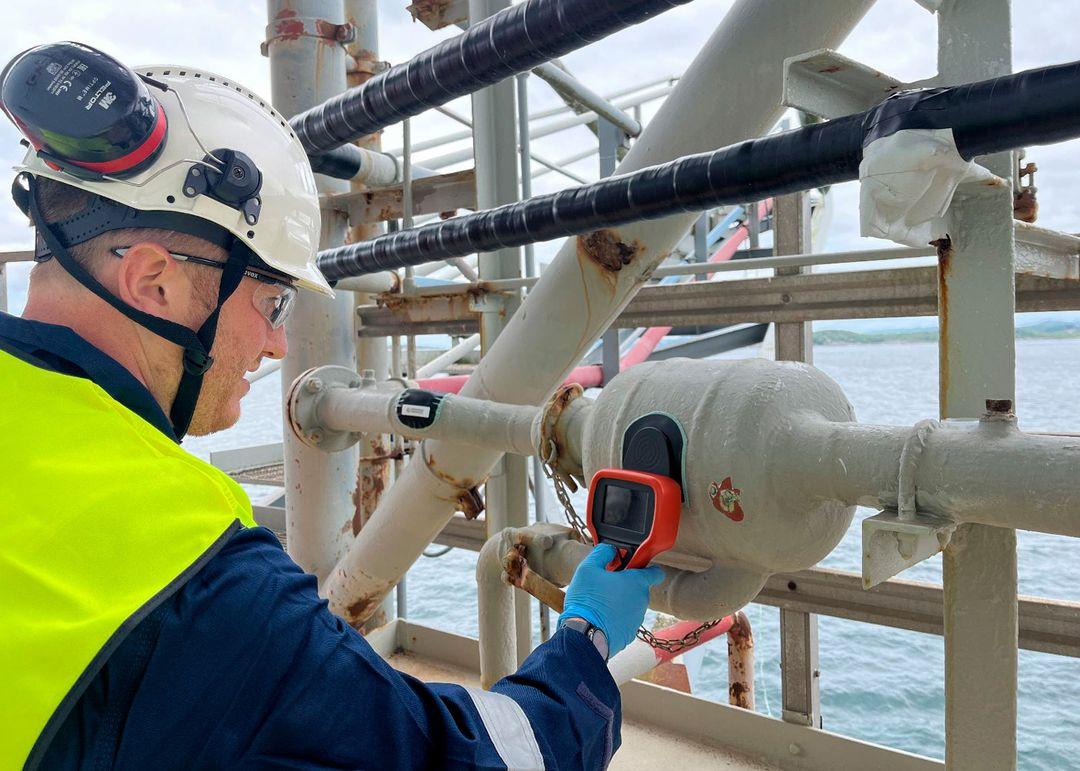
Real Time Corrosion Monitoring Using Sensor Technology
Keywords:
Corrosion Monitoring, Sensor Technology, Real Time Monitoring, Marine Structures, Offshore StructuresAbstract
Corrosion is one of major problems affecting marine and offshore structures because continuous exposure to seawater, humidity, and or environmental conditions can accelerate material deterioration. If corrosion is not detected at an early stage, it can reduce structural strength and increase maintenance costs. refore, an effective corrosion monitoring system is needed to identify corrosion conditions and support timely maintenance. This article discusses application of sensor technology for real time corrosion monitoring in marine and offshore structures. Sensors can collect information related to corrosion conditions and transmit monitoring data continuously, allowing changes in material conditions to be detected more quickly. collected data can be analyzed to evaluate corrosion development and support decisions regarding inspection and maintenance. application of real time sensor based monitoring can improve efficiency of corrosion management, reduce risk of unexpected structural damage, and support long term structural integrity of marine infrastructure. However, factors such as sensor reliability, environmental conditions, data accuracy, installation, and maintenance still need to be considered to ensure effective monitoring performance.
References
[1] R. Xia, C. Jia, and Y. Garbatov, “Deterioration of marine offshore structures and subsea installations subjected to severely corrosive environment: A review,” Mater. Corros., vol. 76, pp. 758–775, 2024, doi: 10.1002/maco.202314050.
[2] M. Abbas and M. Shafiee, “An overview of maintenance management strategies for corroded steel structures in extreme marine environments,” Mar. Struct., vol. 71, p. 102718, 2020, doi: 10.1016/j.marstruc.2020.102718.
[3] A. J. Olesen, L. V. Nielsen, L. Hilbert, and F. Fontenay, “Design and Implementation of an Offshore Remote Monitoring System for Corrosion, Coating and Cathodic Protection Performance,” in CONFERENCE 2023, 2023. doi: 10.5006/c2023-19265.
[4] R. Brijder et al., “Review of corrosion monitoring and prognostics in offshore wind turbine structures: Current status and feasible approaches,” vol. 10, 2022, doi: 10.3389/fenrg.2022.991343.
[5] R. Wright, P. Lu, J. Devkota, F. Lu, M. Ziomek-Moroz, and P. Ohodnicki, “Corrosion Sensors for Structural Health Monitoring of Oil and Natural Gas Infrastructure: A Review,” Sensors (Basel)., vol. 19, 2019, doi: 10.3390/s19183964.
[6] J. Ahuir-Torres et al., “Benchmarking parameters for remote electrochemical corrosion detection and monitoring of offshore wind turbine structures,” Wind Energy, 2019, doi: 10.1002/we.2324.
[7] A. Momber and M. Wilms, “The use of meteorological and oceanographic sensor data in the German offshore territory for the corrosion monitoring of marine structures,” Ocean Eng., 2022, doi: 10.1016/j.oceaneng.2022.110994.
[8] R. Cao et al., “High precision integrated sensors for multi-parameter online monitoring in salt spray environments,” Microsystems Nanoeng., vol. 11, 2025, doi: 10.1038/s41378-025-00988-2.
[9] D. Zou, W. Luo, Q. Chen, X. He, and T. Liu, “Corrosion evolution and quantitative corrosion monitoring of Q355 steel for offshore wind turbines in multiple marine corrosion zones,” Ocean Eng., 2024, doi: 10.1016/j.oceaneng.2024.119044.
[10] U. C. Thibbotuwa, A. Cortés, and A. Irizar, “Small Ultrasound-Based Corrosion Sensor for Intraday Corrosion Rate Estimation,” Sensors (Basel)., vol. 22, 2022, doi: 10.3390/s22218451.
[11] J. Chen et al., “Non-Uniform Corrosion Monitoring of Steel Pipes Using Distributed Optical Fiber Sensors in the Fluctuation Zone of a Coastal Wharf,” Sensors (Basel)., vol. 25, 2025, doi: 10.3390/s25103194.
[12] M. Hassanzadeh, N. Larché, E. Diler, J. Becker, B. Rossi, and R. Dewil, “Application of Electrical Resistance Probes for Corrosion Monitoring and Cathodic Protection Assessment of Offshore Structures,” Mater. Corros., vol. 77, pp. 1145–1158, 2026, doi: 10.1002/maco.70138.
[13] M. E. A. Ben Seghier, T. Truong, C. Feiler, and D. Höche, “A hybrid deep learning model for predicting atmospheric corrosion in steel energy structures under maritime conditions based on time-series data,” Results Eng., 2025, doi: 10.1016/j.rineng.2025.104417.
[14] A. Silva-Campillo, F. Pérez-Arribas, and J. Suárez-Bermejo, “Health-Monitoring Systems for Marine Structures: A Review,” Sensors (Basel)., vol. 23, 2023, doi: 10.3390/s23042099.
[15] M. Komary, S. Komarizadehasl, N. Tošić, I. Segura, J. Lozano-Galant, and J. Turmo, “Low-Cost Technologies Used in Corrosion Monitoring,” Sensors (Basel)., vol. 23, 2023, doi: 10.3390/s23031309.
[16] P. Vourna, A. Ktena, E. Hristoforou, and N. Papadopoulos, “Assessment of Corrosion in Naval Steels Submerged in Artificial Seawater Utilizing a Magnetic Non-Destructive Sensor,” Sensors (Basel)., vol. 25, 2025, doi: 10.3390/s25165015.
[17] B. Buhr, L. P. L. Raun, R. Sørensen, Y. Rezania, and A. Diederichs, “Benefits of Continuous Corrosion Monitoring for Offshore Wind Structures,” in CONFERENCE 2023, 2023. doi: 10.5006/c2023-19288.
[18] L. Fan and X. Shi, “Techniques of corrosion monitoring of steel rebar in reinforced concrete structures: A review,” Struct. Heal. Monit., vol. 21, pp. 1879–1905, 2021, doi: 10.1177/14759217211030911.