Sustainable Approaches to Corrosion Control and Protective Coatings
Keywords:
Corrosion, Corrosion Control, Protective Coating, Eco-Friendly Materials, SustainabilityAbstract
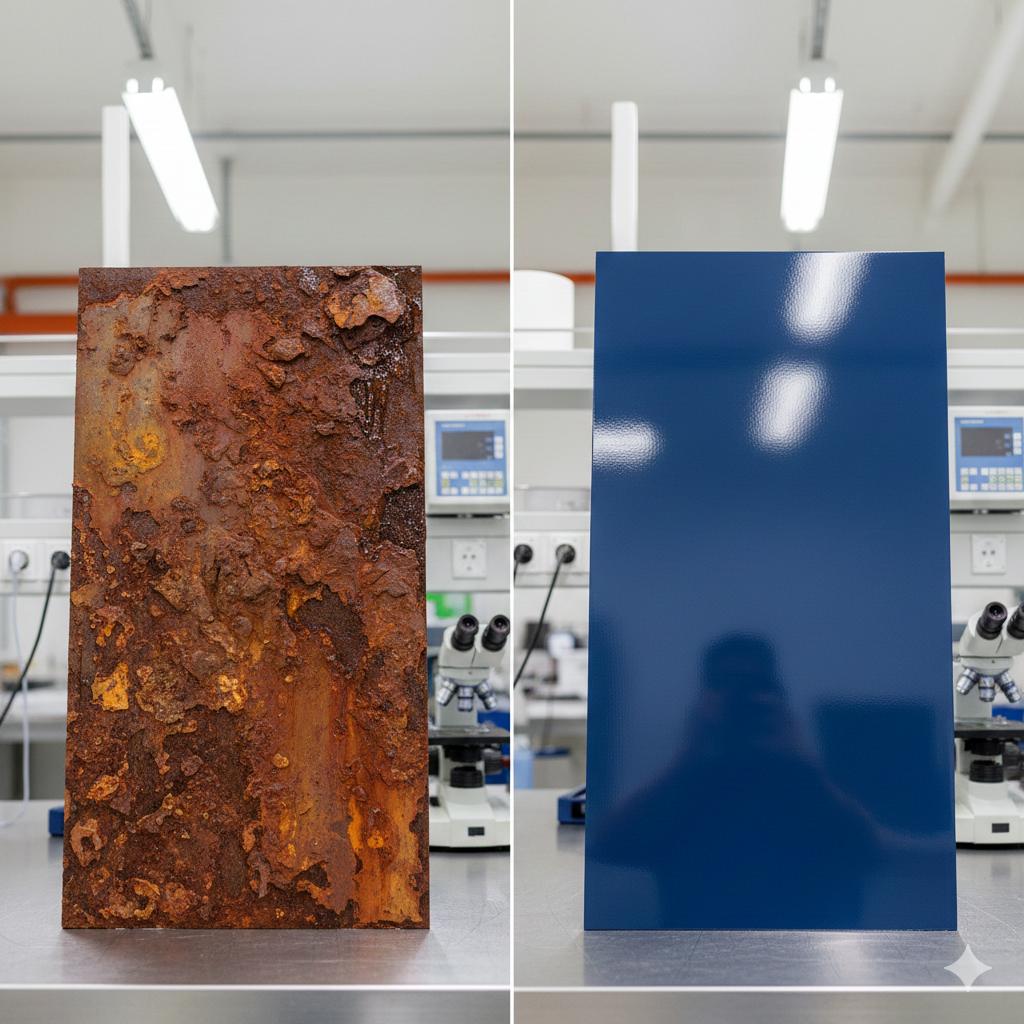
Corrosion is one of the main problems that can reduce the lifespan, reliability, and performance of materials, especially in the industrial, infrastructure, transportation, and energy sectors. Conventional corrosion control generally uses chemicals and coating methods that have the potential to have an impact on the environment and health. Therefore, a more sustainable approach is needed through the development of environmentally friendly materials, natural source-based corrosion inhibitors, and protective coating technologies with low toxicity levels. A sustainable approach in corrosion control not only focuses on improving the resistance of materials to corrosive environments, but also considers resource efficiency, waste reduction, safety, and environmental impact throughout the material life cycle. The development of polymer-based coatings, nanocomposites, bio-based materials, and coating technologies with lower energy and chemical consumption is one potential research direction. In addition, characterization of mechanical properties, adhesion, resistance to corrosive environments, and durability of coatings is necessary to ensure the effectiveness and service life of materials. The implementation of this strategy is expected to be able to produce an effective, economical, environmentally friendly, and sustainable development system. Thus, the integration of material innovation, coating technology, environmental management, and life cycle evaluation is an important aspect in realizing sustainable corrosion control.
References
[1] M. Saikia, T. Dutta, N. Jadhav, and D. Kalita, “Insights into the Development of Corrosion Protection Coatings,” Polymers (Basel)., vol. 17, 2025, doi: 10.3390/polym17111548.
[2] D.-I. Răuță, E. Matei, and S. Avramescu, “Recent Development of Corrosion Inhibitors: Types, Mechanisms, Electrochemical Behavior, Efficiency, and Environmental Impact,” Technologies, 2025, doi: 10.3390/technologies13030103.
[3] X. Liu, “Review of protective coatings for corrosion mitigation in chemical machinery: performance and mechanical aspects,” J. Adhes. Sci. Technol., vol. 40, pp. 1657–1706, 2025, doi: 10.1080/01694243.2025.2599172.
[4] A. Lalem et al., “Eco-Friendly Corrosion Inhibitors Based on Natural Extracts, Biopolymers, and Nanocomposites,” Int. J. Electrochem. Sci., 2026, doi: 10.1016/j.ijoes.2026.101405.
[5] M. Z. A. Khan, H. Khan, and M. Aziz, “Harvesting Energy from Ocean: Technologies and Perspectives,” Energies, 2022, doi: 10.3390/en15093456.
[6] T. Prošek, P. Keil, and K. Popova, “Corrosion Protection and Sustainability: Why Are the Two Concepts Inherently Intertwined,” Corros. Mater. Degrad., 2025, doi: 10.3390/cmd6030038.
[7] M. Sheydaei, “The Use of Plant Extracts as Green Corrosion Inhibitors: A Review,” Surfaces, 2024, doi: 10.3390/surfaces7020024.
[8] T. Zayed, “A Comprehensive Review of Corrosion Protection and Control Techniques for Metallic Pipelines,” Eng. Fail. Anal., 2022, doi: 10.1016/j.engfailanal.2022.106885.